
Key points
From the olive grove to the table: three essential steps
The quality of an extra virgin olive oil is built into every detail. From the origin of the olives to the rigorous selection of the fruit, through to extraction, storage and bottling, each stage helps to preserve the flavour, freshness and authenticity of Manos Lince Olive Oil.

Manos Lince
01Controlled origin
Quality begins in the olive grove: choosing the right time to harvest, the condition of the fruit and the care taken during transport all help to preserve the olives’ natural freshness.
Featured
02Rigorous selection
Every stage counts. From reception to cold extraction, we monitor the key factors to preserve the flavour, aroma and balance of the extra virgin olive oil.
Featured
03Quality right to the table
Filtration, storage and bottling complete the process, ensuring that the olive oil reaches the consumer with its identity, stability and authenticity intact.
Origin
A quality built up, step by step
A great olive oil is not simply ‘pressed’ from an olive. It is preserved. The potential for quality is formed within the fruit and can be maintained – or lost – in every minute between harvest and bottling. That is why the true process begins long before the machine comes into play and ends only when the consumer tastes an olive oil that is fresh, balanced and free from defects.
This article presents the complete journey of an extra virgin olive oil of excellence, using accessible language and technical detail: ripening, harvesting, transport, sorting, cleaning, milling, beating, centrifuging, filtering, quality control, storage, bottling and tasting.
Manos LinceThe olive mill’s mission is not to create quality from scratch: it is to safeguard, with precision, the quality that has come from the olive grove.
The Step-by-Step Process
From fresh olives to extra virgin olive oil

THE MOST DEMANDING CATEGORY
What does ‘extra virgin olive oil’ mean?
The term ‘extra virgin’ is not a slogan. It is a technical category. Virgin olive oil is obtained from the fruit of the olive tree exclusively by mechanical means or other physical processes that do not alter the product; the permitted treatments are washing, decanting, centrifugation and filtration. There is no chemical refining, neutralisation, deodorisation or blending with refined oils.
To be classified as extra virgin olive oil, olive oil must meet both physico-chemical and sensory requirements. The free acidity, expressed as oleic acid, must not exceed 0.8 g per 100 g. However, acidity, on its own, is not enough: in the official tasting, the median of defects must be zero and the fruity attribute must be present.
‘Cold-extracted’ is important, but it is not automatically synonymous with ‘extra virgin’
In the European Union, the term “cold-extracted” may only be used for virgin or extra virgin olive oils obtained by percolation or centrifugation of the paste at a temperature below 27 °C. The moderate temperature helps to preserve aromas and sensitive compounds, but it does not remedy damaged, fermented or over-stored olives. Excellence results from the process as a whole.
RAW MATERIALS
Before the harvest: quality begins with the olive tree
The potential of the olive oil is determined in the olive grove. Variety, climate, soil, water availability, plant health and ripeness all influence the yield and aromatic profile. Olives intended for premium olive oil must be healthy, free from severe pest infestation, rot, frost damage or any damage that exposes the flesh to air and microorganisms.
Choosing the right stage of ripeness
During ripening, the skin generally changes from green to purplish and then black, whilst the flesh also transforms. An earlier harvest tends to produce olive oils that are greener, more aromatic, bitter and pungent; a later harvest usually results in more mature and mellow profiles. The producer seeks a balance between yield, extractability, aromatic intensity, stability and the desired style.
In terms of technical management, successive sampling may be carried out to monitor the rate of ripening, olive oil content, moisture, extraction capacity and sensory development. There is no universal date: each variety, plot and harvest season requires its own decision.
THE FIRST CRITICAL MOMENT
Harvest: speed and respect for the fruit
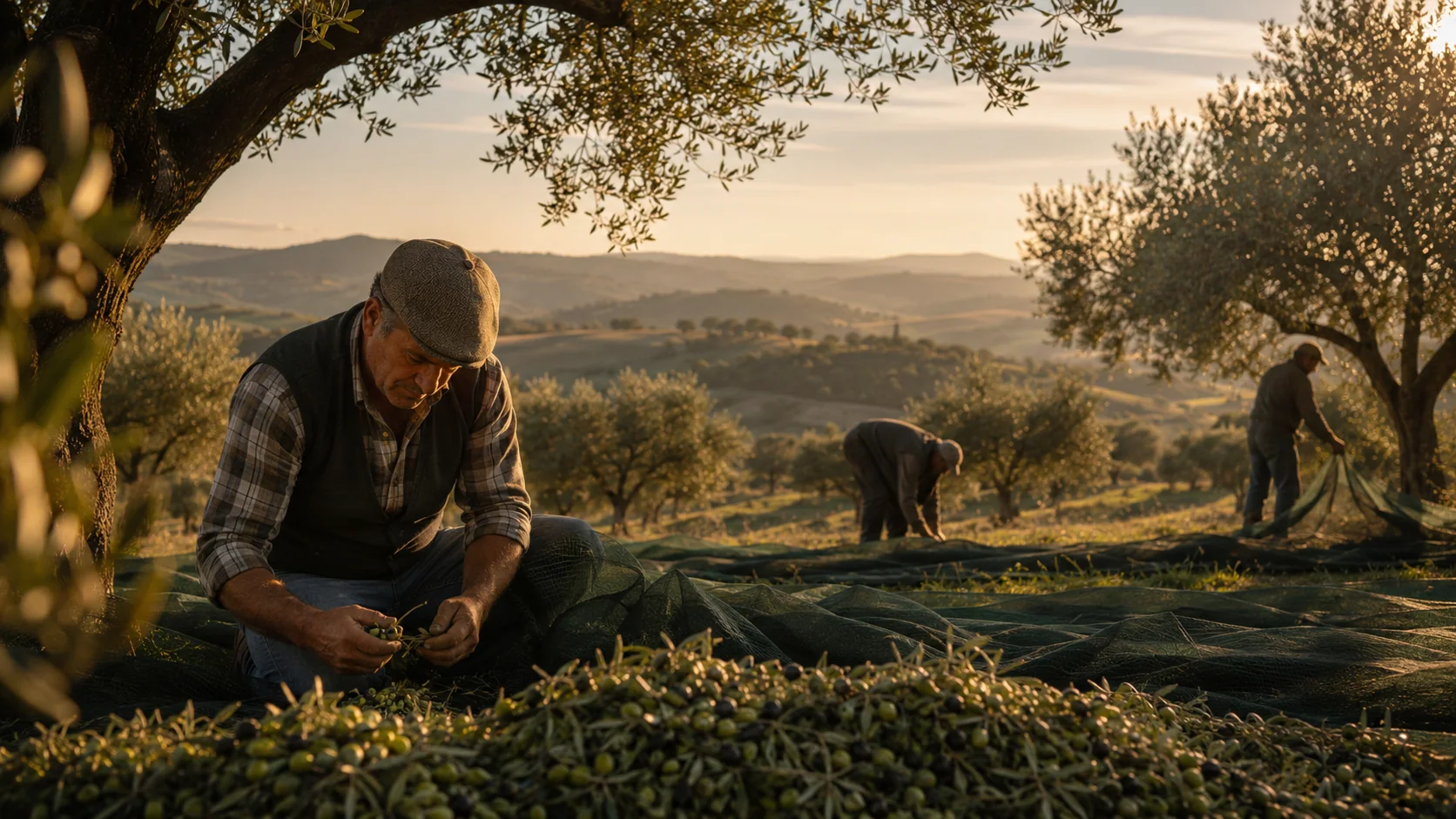
Harvesting can be done by hand, assisted by electric or pneumatic rakes, by shaking the branches and trunk, or mechanised in suitable olive groves. The method must detach the fruit with minimal impact and crushing. Nets or collection systems prevent direct contact with the ground and reduce the incorporation of soil, stones and moisture.
Olives picked up from the ground, those that are badly damaged or show signs of fermentation, must be separated from olives harvested directly from the tree. Mixing raw materials of different qualities dilutes the identity of the batch and may introduce defects into the entire volume produced.
The clock starts ticking the moment the olive falls
After harvesting, the fruit remains biologically active. In compact piles, sealed sacks or unventilated containers, it heats up, loses water, becomes crushed and creates conditions conducive to fermentation. The rule for quality is simple: transport quickly, allow air to circulate and process as soon as possible — ideally on the same day, where logistics permit.
TRACEABILITY
Transport, reception and sorting: every batch counts
The olives must be transported in clean food-grade boxes or containers, preferably ventilated and deep enough to prevent the bottom layer from being crushed. Bags compress the fruit and reduce ventilation; therefore, they are not the recommended solution for quality-oriented production.
On arrival at the olive mill, the batch is identified and weighed. The following are recorded: the origin, the plot, the producer, the variety, the date and time of harvest, the weight and the condition of the fruit. A representative sample allows for the assessment of ripeness, moisture content, impurities, damage, any presence of pests and likely yield.
Separate before processing
Batches of different varieties, varying degrees of ripeness or uneven quality may require specific parameters for crushing, beating and centrifugation. Sorting prevents compromised fruit from contaminating sound fruit in terms of sensory qualities and makes it possible to create homogeneous batches with clear identity and traceability.
PREPARATION OF THE OLIVES
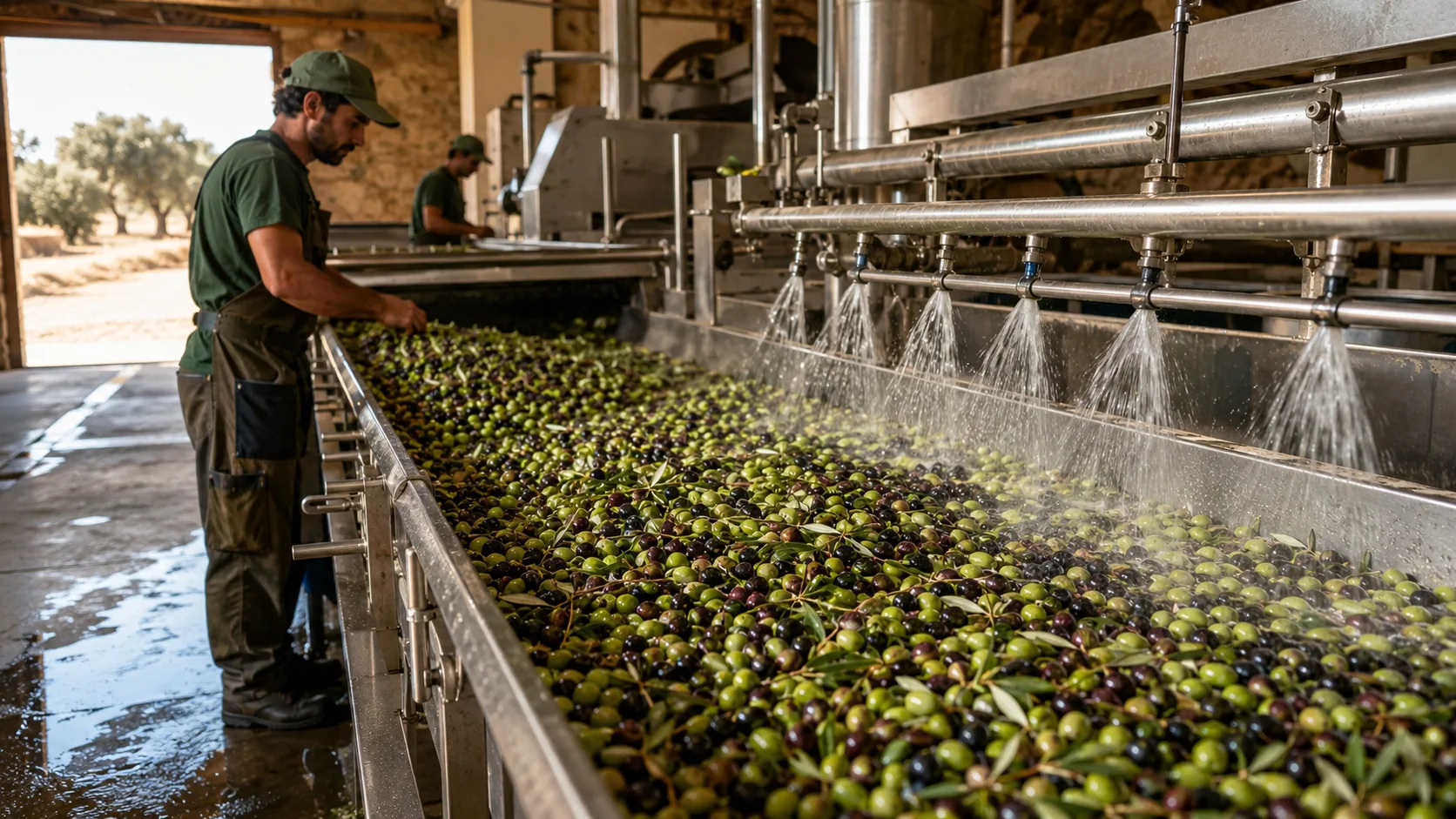
Cleaning and washing: only what matters remains
Before milling, draughts, vibration and sieves remove leaves, small twigs and light materials. Stones, soil and other mineral impurities are removed by cleaning equipment and, where necessary, by washing with controlled, potable water.
Washing must be proportional to the need. Clean fruit, picked straight from the tree and transported properly, requires less intervention than fruit covered in mud or dust. The water must maintain hygienic standards, be replaced regularly and must not carry odours, microorganisms or contaminants from one batch to another.
Why is this stage critical?
Soil and stones can damage equipment and introduce earthy notes. Excess leaves can alter the aromatic balance. Contaminated water can compromise hygiene, particularly when the fruit’s skin is damaged. Thorough cleaning means removing any harmful elements without unnecessarily prolonging the olive’s contact with the water.
MECHANICAL PROCESSING
Pressing: extracting the olive oil contained in the fruit
The whole olive enters the mill and is crushed until it forms a paste consisting of a solid phase, vegetation water, olive oil microdroplets and volatile compounds. The aim is to break down the cellular structures and release the olive oil stored in the vacuoles of the pulp.
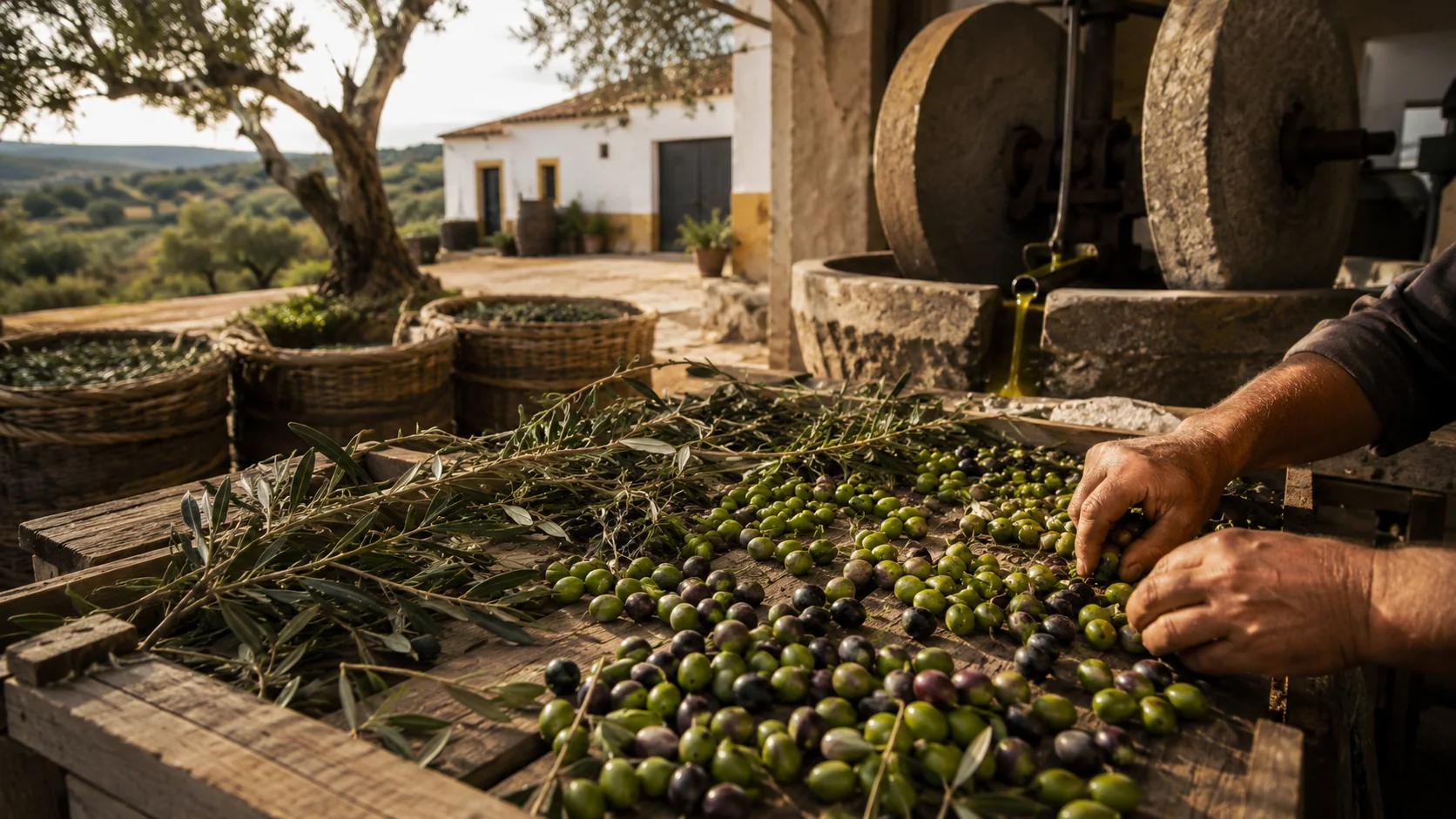
The grinding process can be carried out using hammer mills, disc mills, blade mills or traditional stone-milling systems. In modern systems, screens and speed control regulate the particle size of the paste. The settings depend on the variety, ripeness and consistency of the fruit: a paste that is too fine may form emulsions that are difficult to separate; a paste that is too coarse may reduce olive oil yield.
Speed, cleanliness and temperature
The mill must be clean, free from residues of previous batches, and must operate without excessive heating. The paste is immediately sent to the mixing tank. At this stage, exposure to air must be controlled, as the enzymes responsible for some of the desirable aromas also contribute to oxidation reactions that can degrade the product.
MIXING OR THERMAL BATTERING
Blending: combining the microdroplets without losing freshness
After pressing, the olive oil is dispersed into thousands of microdroplets. In the mixer, paddles slowly stir the paste so that these microdroplets collide and form larger droplets, which are easier to separate in the decanter. This is a process of coalescence, not ‘cooking’.
Time, speed, temperature and contact with oxygen are adjusted to suit the behaviour of each paste. Insufficient mixing reduces separation; mixing for too long or at too high a temperature can diminish aromatic intensity, accelerate oxidation and produce heated notes. Closed or atmosphere-controlled systems help to limit contact with air.
Below 27 °C for the term ‘cold-extracted’
When seeking to use this designation, the temperature of the paste must remain below 27 °C during extraction by percolation or centrifugation. This control must be effective and recorded. More importantly, temperature management must form part of an overall approach that includes sound raw materials, rapid processing, hygiene and the protection of the olive oil after extraction.
SEPARATION BY DENSITY
Extraction: centrifugation, unrefined
The blended paste enters a horizontal centrifuge, known as a decanter. The high centrifugal force separates the components according to their density. The olive oil, being less dense, separates from the freesqueeze water and the solid fraction, the pomace.
Two-phase system
In the two-phase system, two main streams emerge from the decanter: olive oil and wet pomace, which contains a large proportion of the vegetable water. This system reduces the need to add water and produces less liquid effluent, but results in pomace with a higher moisture content.
Three-phase system
In the three-phase system, the decanter discharges olive oil, pomace and waste water in separate streams. It may require a greater addition of water and generates more liquid effluent. In both cases, the regulation of flow rate, differential speed, water and temperature must be adapted to the characteristics of the paste.
Vertical separator
After the decanter, the olive oil may pass through a vertical centrifuge which removes small quantities of water and fine particles. The result is a freshly extracted olive oil that is still very young, aromatic and delicate: from this point onwards, any contact with air, light, heat, water and sediments must be minimised.
STABILISING WITHOUT REFINING
Clarification, filtration and quality control
Freshly-extracted olive oil may contain microdroplets of water, small particles of pulp and air bubbles. Decanting, racking and filtration are physical processes designed to clarify and stabilise the product. Filtering does not mean refining: filtration is permitted in the production of virgin olive oils and removes suspended matter that could lead to fermentation or degradation reactions.
Some olive oils are marketed unfiltered to highlight a cloudier appearance and to encourage consumption whilst still very young. In this case, managing time and temperature becomes even more demanding, as water and suspended solids reduce stability. For a more predictable shelf life, filtration is generally recommended.
Physico-chemical analyses
The laboratory confirms the category and monitors stability using parameters such as free acidity, peroxide value, ultraviolet absorbance and other regulatory criteria. These results reveal various aspects: fruit integrity, primary oxidation, ageing or any non-compliance with purity standards.
Sensory analysis
A trained panel assesses fruitiness, bitterness, pungency and possible defects. For the extra virgin category, there must be no detectable sensory defect in the panel’s median assessment, and fruitiness must be greater than zero. Chemical analysis and tasting are not mutually exclusive: they complement one another.
| Stage | What to check | risk avoided |
|---|---|---|
| Olive grove and harvest | Health status, ripeness and integrity of the fruit | Off-flavours, high acidity, loss of freshness |
| Transport and delivery | Time, ventilation, cleaning and batch separation | Fermentation, heating and cross-contamination |
| Washing and milling | Drinking water, hygiene, particle size and speed | Earthiness, off-odours, emulsions and loss of yield |
| Crushing and extraction | Temperature, duration, oxygen and decanter adjustment | Oxidation, loss of aroma and sensory imbalance |
| Filtration and storage | Moisture, sediment, light, air and temperature | Fermentation, unstable cloudiness and rancidity |
| Bottling | Moisture, sediment, light, air and temperature | Fermentation, unstable cloudiness and rancidity |
STORAGE AND PRESERVATION
Storage: protecting olive oil discreetly
Once graded, the olive oil is transferred to tanks made of inert material, usually food-grade stainless steel, with a conical or sloping base to facilitate the removal of sediment. The tanks must be airtight, labelled by batch and, ideally, equipped for filling, sampling and inerting.
The headspace above the olive oil is filled with an inert gas, such as nitrogen or argon, to minimise contact with oxygen. The room must remain dark, free from foreign odours and at a stable temperature. The International Olive Council’s quality guide specifies a temperature range of 12 to 22 °C for the interior of the tanks in the olive mill.
Racking to separate the olive oil from the sediment
Even after centrifugation, sediment may settle at the bottom. If it remains in contact with the olive oil for too long, it may ferment and cause defects. Racking transfers the clear olive oil to another tank, leaving the sediment behind. The timing of this operation depends on the cloudiness, the type of filtration and the storage strategy.
Manos LinceGood packaging does not add to the quality of the olive oil: it prevents the quality that has already been achieved from being lost.
FINAL PROTECTION
Bottling: quality goes into the bottle

Before filling, bottles, caps, pipework and equipment must be sanitised and free from water, detergents and odours. The olive oil is transferred gently, with minimal turbulence and contact with air. Where possible, the headspace in the packaging is inerted before sealing.
The primary packaging must limit the entry of light and oxygen. Dark glass, tins or opaque containers provide direct protection; clear glass requires a full sleeve or secondary box to prevent exposure to light. The closure must be airtight, compatible with the product and resistant to transport.
Batch, label and traceability
Each unit is assigned a batch number linking the bottle to the tank, the analyses, the filling date and the origin of the raw material. The label identifies the category, quantity, origin where applicable, best-before date, storage conditions and authorised statements. The harvest year should only be indicated when the entire contents come from that harvest.
After bottling
Sealed boxes protect against light and facilitate transport. Warehouses and vehicles must avoid excessive heat and significant temperature fluctuations. At the point of sale, the bottle must not be left in direct sunlight or under intense lighting for long periods. The quality chain continues right through to the consumer’s kitchen.
SENSORY VERIFICATION
Tasting: assessing the olive oil with your nose and palate

In the official assessment, the olive oil is served in a dark, covered glass, in a quantity of approximately 14 to 16 ml and kept at 28 ± 2 °C. The dark glass prevents the colour from influencing the taster: an intense green does not necessarily mean better quality, and a golden olive oil can be excellent.
How to taste at home
1
Warm it up — hold the glass in your hand, cover it and swirl it gently to release the aromas.
2
Smell — inhale in short bursts and look for notes of fresh olives, grass, leaves, tomato plants, apples or almonds.
3
Taste — let a small sip spread through your mouth and draw in a little air to activate the retronasal passage.
4
Feel — note the bitterness on the tongue and the spiciness in the mouth or throat; assess how well they blend together.
5
Conclude — observe harmony, complexity and persistence; check for any rancid, mouldy or fermented notes.
The three fundamental positive attributes
• Fruity: a range of aromas characteristic of healthy, fresh olives; may be green or ripe.
• Bitter: a characteristic flavour, most common in olive oils made from green olives or those changing colour.
• Pungency: a tactile sensation that may arise in the mouth and, above all, in the throat; it is common in young olive oils.
In a top-quality olive oil, these attributes need not all be of equal intensity, but they must form a clean, coherent and persistent profile. Tasting transforms the technical process into an experience: it is in the glass that one can tell whether the freshness of the fruit has survived the entire production chain.
CIRCULAR ECONOMY
Sustainability: making the most of what remains from the process
Production generates leaves and small twigs, stones, olive pomace and wastewater in quantities that vary depending on the extraction system. These waste streams should not be treated as a minor detail: their management forms part of the overall quality of the olive mill and the protection of the soil and water.
Depending on local legislation and solutions, leaves and twigs can be sent for composting; pits and dry fractions may be used for energy recovery; the pomace may be sent for extraction, composting, biomass or other industrial uses; wastewater requires controlled treatment and disposal. Two-stage systems reduce liquid effluent, although they concentrate more moisture in the pomace.
Efficiency is also quality
Reducing olive oil losses in the pomace, reusing water only in technically suitable circuits, controlling energy consumption, keeping equipment well-maintained and planning the harvesting season all reduce environmental impact and improve product consistency. Sustainability begins with measurable operational decisions.
CONCLUSION
From the olive grove to the table: a chain of trust
The journey of extra virgin olive oil can be summed up in one idea: preserving the fruit. Harvest at the right moment, avoid damage, transport with adequate ventilation, separate batches, clean thoroughly, mill quickly, beat with care, centrifuge with precision, filter and store away from light and oxygen, bottle hygienically and confirm the profile in the glass.
Each stage leaves its mark on the final product. When the process is carried out correctly, the olive oil retains vivid aromas, balanced bitterness and piquancy , a clean texture and a lingering finish. It is this continuity — from the olive grove to the bottle — that transforms an ancestral foodstuff into a contemporary premium product.
Manos LinceManos Lince: the identity of an olive oil is revealed in the bottle, but begins long before that, in the care taken with every olive.
REFERENCES
Technical sources and editorial note
The technical content has been prepared on the basis of official standards and guidelines from the International Olive Council, European Union legislation and Portuguese technical documentation. The exact operational parameters — malaxation duration, decanter settings, filtration and batching strategy — must be validated against the records and equipment actually used by Manos Lince prior to publication as a specific description of the production facility.
• Delegated Regulation (EU) 2022/2104 — marketing standards for olive oil.
• INIAV — Good Practices in the Olive Grove and at the Olive Mill.